Rowing with a cause: get to know the Pink Ribbonettes
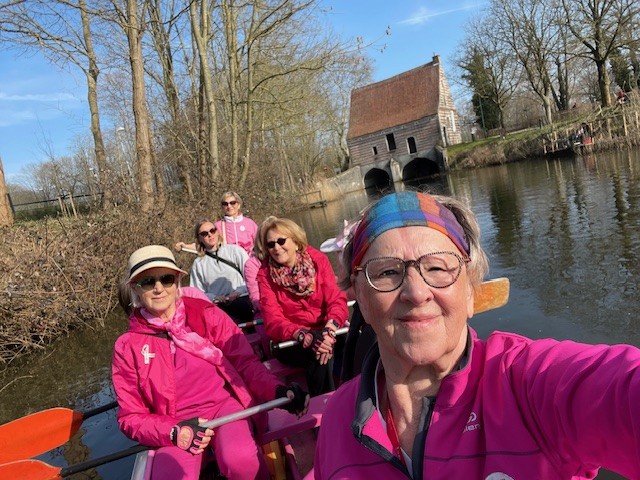
The Pink Ribbonettes are groups of (ex-)breast cancer patients who row together with a multiple goal: fellow sufferers contact, rehabilitation and fun. In Belgium, the initiative, in the bosom of the non-profit organization Pink Ribbon, will soon celebrate its 10th anniversary.
A lot of breast cancer patients suffer from a thick arm (lymphedema) after breast surgery, especially in combination with axillary gland clearance. This complication can be quite stressful, but intensive upper-body exercise helps reduce the discomfort. It gave Canadian physical therapist Don McKenzie, of the University of British Columbia, the idea in the mid-1990s of paddling a group of breast cancer patients together in a dragon boat. A dragon boat is a long, narrow boat in which 20 paddlers, sitting in pairs side by side, can sit. McKenzie found that of his group of patients, none developed a thick arm and in those with an existing thick arm, paddling offered improvement. The movements when paddling provide lymphatic drainage. The women themselves really enjoyed the workouts and continued to paddle together. Thus "abreast in a boat" (meaning shoulder to shoulder in a boat) was born. The success soon led to the creation of other dragon boat teams in Canada, inspired by 'abreast in a boat.' Other countries followed, and the idea was also picked up in Europe, including Venice. Currently, there are groups all over the world, from Canada to China. They number several thousand members.
%20PNG.png)
Venice
Monique Quaeyhaegens, founder of the Pink Ribonettes group in Lier was there when a group of Belgian former breast cancer patients went to Venice to take a look at the peddling group of breast cancer patients. The initiative came from Rosette Van Rossem, then a board member of the Pink Ribbon non-profit organization. Rosette had heard of 'abreast in a boat' and wanted to set up something similar in our country. A letter of motivation was requested to get acquainted and join the Italian boat. Monique: "I sent a letter of motivation to the group in Venice and was allowed to sail with them. It was a year before my retirement and I was toying with the idea of starting a group in Lier after my retirement. In our town, too, water is everywhere.' That group came about with the support of the non-profit organization Pink Ribbon and was called the Pink Ribbonettes . After the Venice visit, several groups were created in Belgium, both in the south and in the north.
With or without a dragon boat
To join a group of Pink Ribbonettes you have had breast cancer, but a fat arm is certainly not a prerequisite. Strength training, such as paddling, is beneficial for all patients. Not all groups have a dragon boat. The groups in Brussels and Turnhout have their own dragon boat. 'On the Nete in Lier, it is difficult to maneuver a dragon boat,' says Monique Quaeyhaegens. 'We use a ten-seat, the one where you do the same paddling movements. Our group is affiliated with the canoe club in Lier. We can use one of their boats.' The Pink Ribbonettes of Lier meet every Sunday morning to paddle on the Nete River, 'When it's really too cold, in pit of winter, we go hiking. We have become a real group of friends.'
Here you can read more about the different groups in Lier, Turnhout and Brussels. Internationally, the paddling groups are united in the International Breast Cancer Paddlers Commission (IBCPC).
Continue reading

Hormone IUD and breast cancer risk
Hormone disruptors and breast cancer



.png)
.png)








.png)