Breast cancer in men: "At the mammogram, they called out: 'Come this way, ma'am!'"

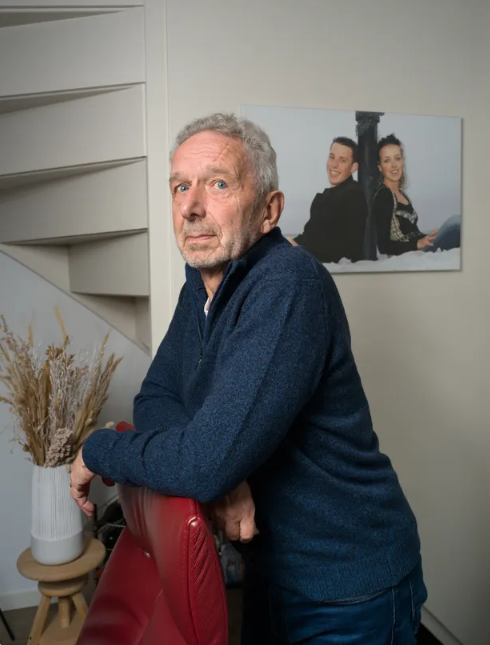
Fred van der Kade (73): "The mammogram was quite difficult, with such small breasts."
I discovered it almost by accident. I was sitting here at home, resting my hand on my chest, as one sometimes does without thinking. And suddenly I felt something. A tiny, beautifully round lump. My first thought was reassuring: a cyst. In my mind, cysts were nice and round, and tumors were irregular. So I thought: it's probably nothing. The next day, just to be sure, I showed it to my wife. She worked in a hospital and knew that men could get breast cancer. So she immediately said: "Go to the doctor." The GP didn't think it was serious, but he did say: "I'm not taking any chances, I'll refer you."
A few days later, I was in the hospital. Still thinking: it's nothing. And then you find yourself in a world that isn't really made for you. First the mammogram, between those plates, just like with women. Quite difficult, with so little breast tissue to put between those plates. And then the ultrasound. I'm lying on that table, the radiologist comes in, presses on it, looks, and says pretty quickly: 'Well, that doesn't look malignant.' Then you think: great, done. But he kept looking. And then came the sentence that turned everything upside down: 'I can't dismiss it. There's one thing I'm not sure about. I want a surgeon to take a look." The surgeon looked and said, "Probably not a cyst, because it's separate from the skin." Back to the radiologist, biopsy. And then it all happened very quickly. The following Thursday, we were back at the surgeon's office. He said it very clearly: "You have breast cancer." That really hit home.
It turned out to be hormone- and protein-sensitive. So that meant surgery, chemotherapy, immunotherapy, and then anti-hormonal therapy. I wanted to get started right away. I said, "Go all out. Do whatever is necessary." The first step was a mastectomy. It was intense, of course, but I didn't have to think about it for a second. Look, if I had been 25, I might have looked at it differently. But I was 68, now 73. I never thought about getting a nipple tattoo or anything like that. I sometimes go to a holiday park with my (grand)children, to the swimming pool, to the beach. Then I sometimes look around: are people staring? Well, no one is. And if I didn't like it, I would just throw my towel over my shoulder and then no one would see anything anyway. Done.
After the surgery, I had chemo and immunotherapy. The hospital gave me a folder with all the possible side effects. And that's how I approached it: not trying to be tough, but practical. I went through that list: "If this happens, what do I do?" Bald? Cap. Dry eyes? No contact lenses, glasses. Nausea? We'll see. And when men ask me if they should do chemo, I say, "I can't decide that for you." If I had been sick as a dog five days a week, I might have thought: just stop. But that wasn't the case. My body hair fell out, my eyelashes fell out, half my eyebrows fell out. But was I really sick? No. I got through it pretty well. And the hair on my head stayed too, thanks to an ice cap during chemo. And more importantly: the treatments worked.
I have been cancer-free for five years now. I go for checkups twice a year, and on March 1, I can stop taking those hormone pills. I realize that I was lucky because I caught it early. Mine was stage 1. In men, it is more common for it to be stage 2, as they live with it longer. And then there is a greater chance that it has already spread further.
Many men gamble without realizing it. They think: oh, it's just a lump, no big deal. You simply don't think about breast cancer. It's a women's disease in people's minds, and also in the organization of healthcare. Fortunately, I don't have any horror stories, but you notice it in small things. During check-ups, they sometimes think you're the partner. And sometimes I can just tell, purely from the reaction of the hospital staff, that I'm the first man with breast cancer they've ever seen. That makes sense, because last year only 178 men in the Netherlands were diagnosed with it. But that's precisely why there's almost no treatment geared toward men.
Research into specific medications for men with breast cancer is simply not interesting for pharmaceutical companies with such a small group. That's harsh, but that's how it works.
Men receive essentially the same anti-hormonal therapy as women. Tamoxifen is the standard treatment. If it does not work or you cannot tolerate it, there are alternatives, but the starting point is the female protocol. Research into specific medications for men with breast cancer is simply not interesting to pharmaceutical companies because the group is so small. That is harsh, but that is how it works.
What you can do is make men more visible. Raise awareness. That has become my thing. Not just to dispel prejudices, but to wake men up: you can get this. Check your breasts. Once a month. And if you feel something, go to your doctor. Don't think, 'It's probably nothing.' That's the pitfall. And yes, then there's the taboo. I really think there's a sense of shame. That many men think it's 'a woman's thing.'
In the Netherlands, it's fragmented: the Dutch Breast Cancer Association does some things, the You Play the Leading Role Foundation does other things. But there is no real, recognizable men's group, such as there is in Belgium, for example. In Belgium, you have borstkankerman.be, which you can join for free if you have breast cancer. I did that right away. I even went to the annual meeting with my wife, a whole day in Mechelen. And then you suddenly meet many more men than you ever see here. A group that understands exactly what it's like to go through a "women's disease" as a man. I'm trying to get that off the ground in the Netherlands too. I try to set up digital contact with fellow sufferers every quarter. The number of registrations is minimal. And when there are any, they are often men I already know. That says it all.
Still, I continue to do it. Because if I don't, who will? I also participate in research as a patient partner, often on quality of life. For example: how men deal with tamoxifen, libido, erection problems, that sort of thing. And I seize every opportunity to tell my story. In interviews, at events, and very occasionally on television.
Last year, I was asked to appear on Het perfecte plaatje, a TV show featuring people who had had cancer and had visible scars. It was a fantastic experience. I received a lot of responses, a crazy amount. Not that people stop me on the street now, it's not that exciting, but the reach is huge. And I just thought: if there is even one man who checks his chest because of this and does go to the doctor, then it was worth it.
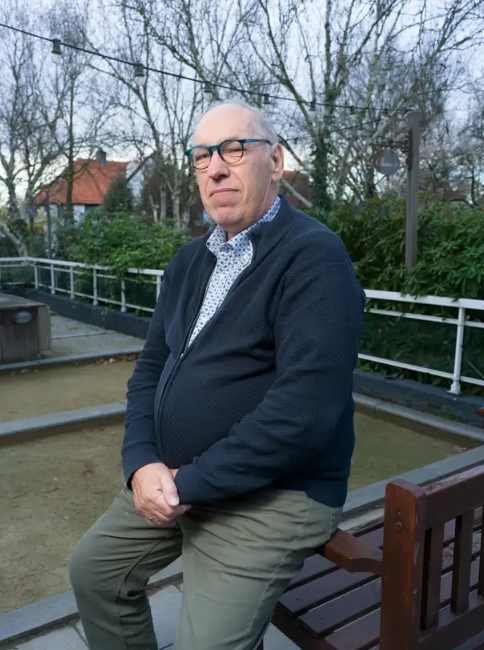
André Pauwels (69): "I was always a tough guy, but since hormone therapy, I've become a softie."
I was 39, had two young children, and had just built a house. I worked as a technician, doing heavy physical work. And suddenly I could no longer do my job. My breast had to be amputated and all my lymph nodes removed. I was no longer allowed to put any strain on my arm. One small wound, one infection, and you run the risk of permanent lymphedema. That's not a minor detail, it's life-changing. I never knew that men could get breast cancer. Just like almost all other men in Belgium.
It started with a recurring rust-colored spot on my shirt. I kept thinking: it's nothing. Cigarette, chocolate, a hole in the fabric. I felt no pain, there was no lump, nothing. One morning I stood naked in front of the mirror and noticed a glint on my nipple. A drop. I dabbed it away and saw that rust color again. Then I knew: this is where it's coming from. My wife immediately said: doctor. I didn't have time, work came first. It was only months later, when she really insisted, that I finally went. After my visit, the family doctor called back immediately and said: "Turn around right now. Go to the hospital."
Then you find yourself in a world where, as a man, you don't expect to be. I was sitting in the waiting room for a mammogram and they called out: "Mrs. Pauwels!" That's no joke. The nurses do this work almost exclusively with women. I was literally put between the plates, which is no easy feat with a man's chest. And then you go home again, waiting for the results. Days later, the doctor said, 'There's something there. It has to go.' The word cancer wasn't mentioned yet. During the operation, my nipple was removed, along with part of the glandular tissue. It was only after the examination that I heard the word that changes everything: breast cancer.
I thought they had made a mistake. "Men can't get that, can they?" It turned out to be early-stage ductal carcinoma. That sounds reassuring, but it isn't. I had to undergo a complete mastectomy. I had no problem with that in itself. Women who have to undergo a mastectomy lose part of their identity. For me, it feels like there's a dent in the car, but the engine still works. I did find it difficult that I could no longer do my job.
I remember going to work on a Saturday afternoon, shortly after being discharged from the hospital. I refused to let my life get derailed. My boss suggested I switch to sales. It felt like failure, but it was necessary. Later, I started doing drafting work, taught myself design software, and eventually became a director. I did that for decades. To be honest, I owe my entire career to my illness. Without breast cancer, I would probably have been walking around with screwdrivers until I retired.
‘What perhaps affected me most was the loneliness. I was in a ward where no one knew how to care for a man after a mastectomy.’
What perhaps affected me most was the loneliness. I was in a ward where no one knew how to care for a man after a mastectomy. The nurses did their best, but they had no routine. I saw a poster in the hallway for a breast cancer patient association. I knocked on the door. The lady looked at me and said, "We don't have anything for men." That hit me hard. I didn't need a wig or a prosthesis, but I did want to know: what will happen to my body? To my sexuality? To my future?
Those questions remained unanswered for years. Until I met other men. First one, then two. And slowly the realization grew: if we do nothing, there will be nothing. That is why, in 2018, together with a small group of fellow sufferers, I founded the association Borstkankerman.be . It started with five men and a pint in a bar, and now there are fifty members spread across Flanders who are actively fighting for visibility, awareness, and contact with fellow sufferers.
Breast cancer in men is one of the most treatable cancers, but men die from it at a higher rate than women. Not because the disease is more aggressive, but because it is detected later. Due to ignorance, shame, and insufficient screening. Men think: it's a women's disease, it won't happen to me. General practitioners sometimes think that too. We know men who have been sent away for months. Some did not survive.
That's why we do what we do. Handing out flyers at soccer games, speaking to medical students, putting on theater performances. We meet regularly, often in small groups, to talk about discovery, sexuality, heredity, death, you name it. That stirs up a lot of emotions. You notice that men only really feel heard once they can talk to someone who has been through the same thing. Our foundation is currently touring Belgium with a photo exhibition featuring portraits and stories of thirteen men who have had a breast amputated. We don't want to shock people, but we do want to confront them. Such impressive photos leave a lasting impression on people.
My own treatment didn't stop after the operation. My tumor was hormone-sensitive, as is the case with most men with breast cancer. So you get the same hormone therapy as women, which is entirely geared towards women. Female hormones, that is. Estrogen. I can tell you: that wrecks your hormonal balance as a man. I became emotional, had hot flashes, and lost my energy. My testosterone production has been permanently destroyed. I used to be a pretty tough guy, but now I cry at the slightest thing.
And thirty years later, I still have to take small doses of testosterone every day to function. That costs me around 150 euros a month. It's not covered by insurance because such small doses of testosterone are linked to athletes who want to improve their performance. Other men receive injections every few months, which are reimbursed, but those peaks are dangerous for me: testosterone can feed the tumor again. You see that inequality everywhere. Medicines that are reimbursed for women, but not for men. We have fought court cases for this. Successfully. And recently, the law has even been amended: no longer 'for women', but 'for patients'. That is a huge victory, but it took years.
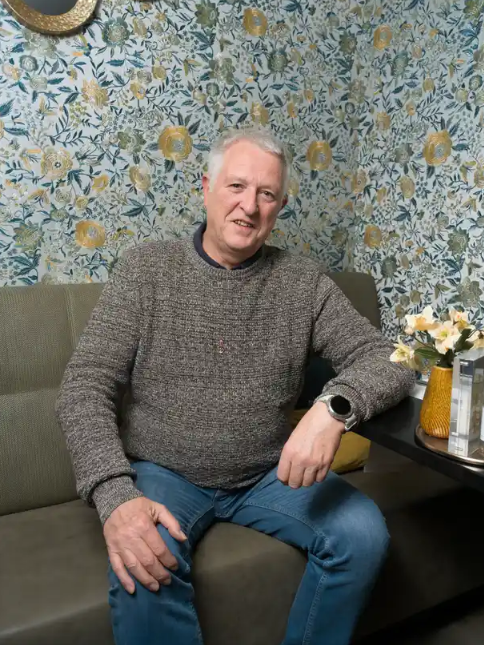
Patrick Bastiaens (66): "I always thought breast cancer was a women's disease."
When the doctor told me I had breast cancer, my first thought was: I must be the first man in Belgium to have it. That's how absurd it sounded. I was 57, already looking forward to retirement. And suddenly I thought: is this where it ends? I was lucky, because I discovered it by chance. I had a bad fall and needed surgery on my shoulder. Torn tendons, a procedure you don't just do on a whim. In preparation, I had to visit the doctor for the standard checks. I stood there with my shirt off and thought: now that I'm here, I'll show him that lump, just below my nipple. Just to be on the safe side.
The GP took a look and immediately became serious. She asked how long I had had it and whether it hurt. I didn't know. That was when I started to worry. She called the hospital straight away. In hindsight, it was a good thing she did. I hadn't thought about breast cancer for a second. I didn't even know men could get it. I thought it was just a fatty lump, nothing special. Not long after, I was sitting in a wheelchair in the hospital and got the results of the biopsy.
The surgeon said, "I'm going to make sure you get to see your grandchildren grow up." That sentence got me through it.
What happened next is etched in my memory. I had to notify my parents and children. My grandchildren flashed through my mind. Who would tell them who their grandfather was? I had never felt that way before. The surgeon, a woman, sensed it. She said, "I'm going to make sure you see your grandchildren grow up." That sentence got me through it. I said, "Get the knives. Do what needs to be done." A week later, my left breast was gone. Completely. The sentinel lymph node was also removed.
Fortunately, it was clean. I didn't need chemo or radiation, but I did need hormone therapy. That's something else men don't talk about much. Hormone therapy affects your masculinity. Your emotions, your body. I became more emotional, had joint pain, hot flashes. Things you associate with menopause. And suddenly I was right in the middle of it.
I have always worked in a managerial position, among people. Early shifts, up early. After my treatment, I tried to return to work. The doctors said: take it easy. I wanted to prove them wrong. It didn't work. My body was empty. After two or three days of work, I was completely exhausted. The other days I had to recover. Nobody sees that, but it's there. And nobody asks your partner how she is doing. In a sense, she also carries that diagnosis.
There was something else at play for me: heredity. During genetic testing, I discovered that I carry a defective breast cancer gene. My father also carried this gene, but fortunately, he never developed breast cancer. However, I can pass it on to my children. That is perhaps the hardest thing of all. Getting cancer is one thing, but knowing that you may have passed it on is something else entirely. I gathered my whole family together and had a family doctor explain how genetics works.
It was an emotional evening. My children have been tested. One of them has the gene. That news breaks something inside you. You feel guilty, even though you know it's not your fault. That's why openness is so important, but also so difficult. Many men don't talk about this. Out of shame, fear, or even concern about things like insurance and mortgages. I understand that, but keeping quiet doesn't help anyone.
When I met other men with breast cancer, something fell away from me. Men who are going through the same thing, who understand without explanation. That's how our support group came about. Small at first, now with about fifty members. We do activities, yes, but the most important thing is talking. About things you don't just tell your friends. The photo exhibition we are currently touring with is an extension of that. We want to use it to raise awareness.
Men need to know what to look out for: a lump, an inverted nipple, discharge. And if they see or feel anything, they should go to the doctor immediately. I once said to my wife, "I don't want another man to die because he didn't know he could get breast cancer." That's still my motivation. And when I see that men are now responding more quickly and getting help faster, I know that this story needed to be told. If this interview has warned even one man with suspicious symptoms, it may well have saved a life.
‘Women’s disease’ that also affects men
As a man, you are more likely to be struck by lightning than to develop breast cancer. In figures: 0.1 percent. The KWF estimates that around 180 men are diagnosed each year with what many people still consider to be a typically female disease. In 2024, there were 178 men with breast cancer, compared to 15,394 women with the same diagnosis.
The difference lies in a combination of factors. Men have much less mammary gland tissue, which is where breast cancer develops. Hormones also play a major role: men produce very little estrogen, whereas many types of breast cancer are stimulated by this hormone. Heredity is relatively important in men; men who develop breast cancer are more likely to have a genetic predisposition. Finally, there is no screening and little awareness, which means that men rarely check themselves and abnormalities are often only discovered at a late stage.
"Many men don't know they have breast tissue at all," says internist-oncologist Robbert van Alphen of the ETZ in Tilburg. "As a result, men often visit the doctor late, or too late, and then the chance of survival is smaller than for women. For women, there is a lot of attention paid to checking their breasts regularly. I think men can also benefit from this. Men should check their breasts themselves, or with the help of their partner, from time to time. Fortunately, we are also seeing increasing awareness among general practitioners, so that they are quicker to recognize breast cancer in men. Pay attention to changes in the nipple or a dimple in the breast. These are signs that should not be ignored."
This article was written by Ryan Claus and published in Nieuwe Revu on January 26.
Original article: https://revu.nl/artikel/676854/borstkanker-bij-mannen-bij-de-mammografie-riepen-ze-komt-u-maar-mevrouw
Continue reading
Hereditary breast cancer is a sword of Damocles
.png)
Reading tips for breast cancer patients


.png)
.png)








.png)